Am I Rich in India? The Honest Truth About Your Net Worth
That feeling when your colleague buys a BMW and you wonder if you're doing something wrong. Spoiler: You're probably richer than you think.
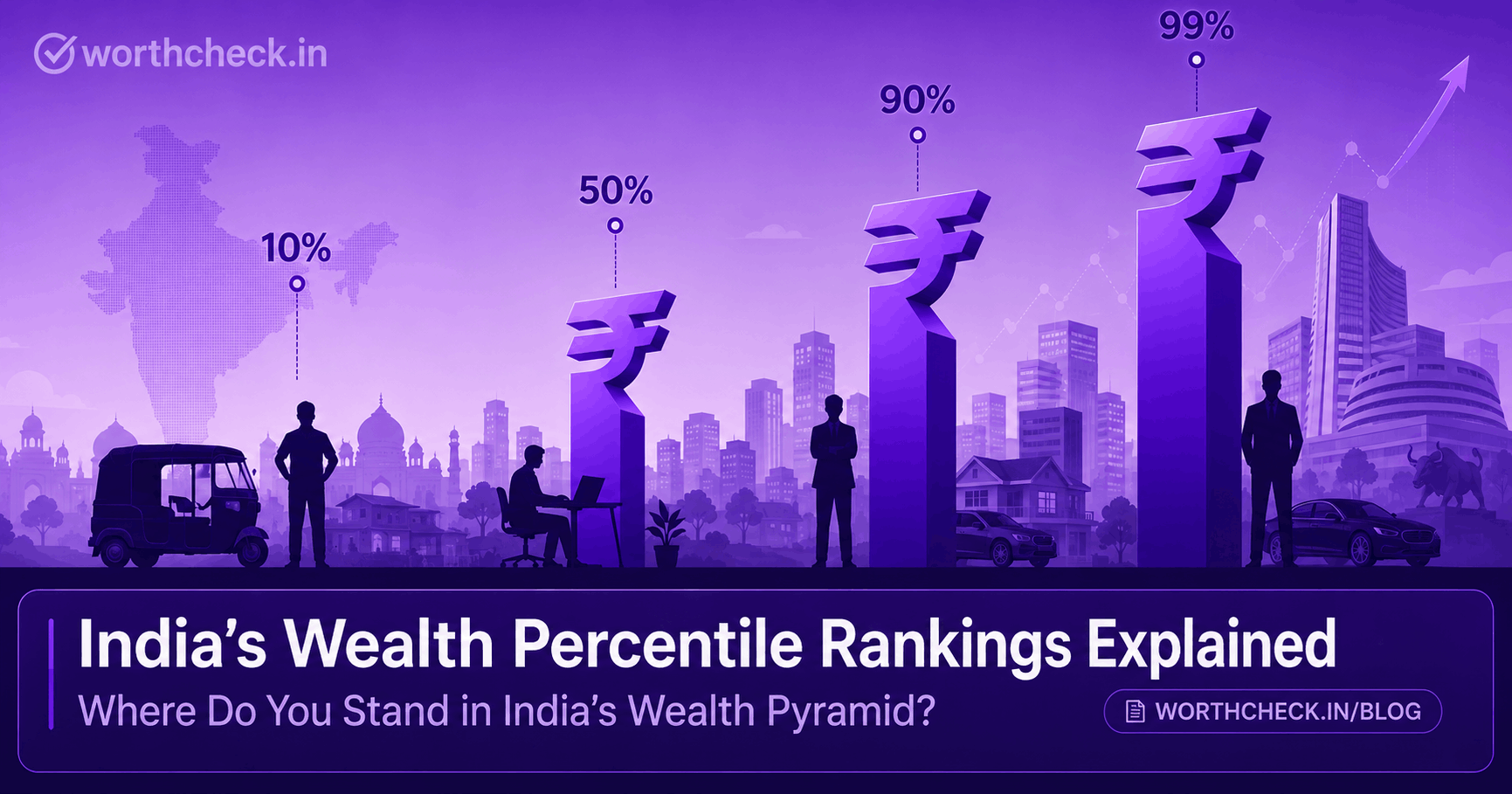
₹3.4L
Median Net Worth
₹70L
Top 10% Threshold
₹6Cr+
Top 1% Club
💰 Quick Verdict
If you have ₹25 lakh in assets...
You're already in the top 20% of all Indians. Yes, that 2BHK you're still paying EMI on probably makes you wealthier than 80% of the country.
If you earn ₹1 lakh/month...
Your income is higher than 99% of Indian taxpayers. That "middle class" feeling? It's your Instagram feed lying to you.
The bottom line:
If you're even googling "am I rich" on a smartphone, you're probably doing better than most. But let me show you the exact numbers.
Let Me Tell You About My Friend Rahul
Rahul earns ₹2.5 lakh per month. He lives in a ₹1.2 crore flat in Bangalore (with a ₹80 lakh home loan). Drives a Honda City. Takes one international trip a year. His wife works too, pulling in another ₹1.8 lakh monthly.
Combined household income: ₹4.3 lakh/month. ₹51 lakh per year.
And Rahul feels "middle class."
Not comfortable. Not wealthy. Just... middle class. Because his boss has a bigger house. His IIT batchmate founded a startup worth ₹500 crores. His neighbor's kid goes to an international school that costs ₹15 lakh a year.
The Reality:
Rahul's household income puts him in the top 0.1% of Indian earners. Not top 10%. Not top 1%. The top 0.1%. Out of 1,000 Indians, he earns more than 999 of them.
This is why "Am I rich?" is such a messed-up question. Your reference points are completely broken. Let me fix that with actual data.
India's Wealth Percentiles: Where Do You Actually Stand?
I pulled data from six authoritative sources for this analysis:
- UBS Global Wealth Report 2025 (formerly Credit Suisse) - gold standard for global wealth data
- World Inequality Database (WID) - maintained by economists Thomas Piketty and Lucas Chancel
- Oxfam India Inequality Report 2025 - latest inequality metrics
- NSSO All India Debt & Investment Survey (AIDIS) - official government survey
- Income Tax Department Statistics 2024-25 - actual taxpayer data
- RBI Household Finance Committee Report - Reserve Bank's household wealth study
No vibes. No feelings. Just numbers from people who actually count money for a living.
| Percentile | Net Worth | What This Means |
|---|---|---|
| Top 1% | ₹6 Crore+ | Richer than 99 out of 100 Indians |
| Top 5% | ₹1.5 Crore+ | Upper class by any definition |
| Top 10% | ₹70 Lakh+ | Comfortably wealthy |
| Top 20% | ₹25 Lakh+ | Upper-middle class |
| Top 40% | ₹6 Lakh+ | Middle class |
| Median (50%) | ₹3.4 Lakh | Half of India has less than this |
| Bottom 30% | Under ₹95,000 | Paycheck to paycheck |
Sources: UBS Global Wealth Report 2025, World Inequality Database, NSSO AIDIS 2023-24
Read that median again: ₹3.4 lakh. That's the price of a decent used scooter. If you have more than that in total assets minus debts, you're in the top half of Indian adults.
If you have ₹25 lakh? Top 20%. That "starter home" you bought in a tier-2 city? It probably makes you wealthier than 8 out of 10 Indians.
🔍 Quick Reality Check
Only 2.4% of Indians even pay income tax. If you're earning enough to be taxed, you're already in an elite club. Out of 1.4 billion Indians, only about 8 crore people file returns with taxable income. Use our income tax calculator to see exactly how much you owe.
📊India's Inequality in Numbers (2025 Data)
40.1%
of India's wealth is held by the top 1%
Source: Oxfam India 2025
77%
of Indians don't invest in stocks/MFs
Source: RBI Household Finance Report
271
Indians are dollar billionaires (2025)
Source: Hurun Rich List 2025
₹94,000 Cr
collective wealth of top 10 Indians
Source: Forbes India Rich List 2025
Income Percentiles: What Your Salary Really Means
Net worth takes time to build. But income? That's easier to benchmark. Here's where different income levels actually rank:
That ₹25 LPA package you thought was "just okay" for an IIT grad? It puts you in the top 1% of all Indian earners. Not Indian software engineers. All Indians. Including farmers, shopkeepers, daily wage workers, and everyone else.
Related: Wondering how much salary you actually need? See our detailed analysis on salary needed to live comfortably in India (2026) broken down by city.
Wealth by Age: Are You Ahead or Behind?
Here's where it gets interesting. Comparing your net worth to the national median is misleading. A 25-year-old with ₹5 lakh is doing way better than a 45-year-old with the same amount.
Let me show you what median net worth looks like by age, so you can compare with your peers:
Notice how net worth peaks around 55-60, then drops slightly. Makes sense - people start spending their savings once they stop working. That 60+ number would be higher if we didn't include retirees actively depleting their corpus.
Just turned 30? Check out our specific guide on how much you should have saved by age 30 in India with actionable benchmarks.
The Doubling Pattern
Median wealth roughly doubles every 10 years from 25-55. ₹3L → ₹8L → ₹18L → ₹35L → ₹55L → ₹90L. If you're not doubling, you're falling behind.
The Critical Window
Ages 35-50 is where most wealth is built. Peak earnings + compounding = exponential growth. Miss this window and catching up becomes very hard.
The 6x Gap
Top 10% has 6-8x the median at every age. At 40: median ₹35L vs top 10% ₹2Cr. This gap is created by starting early and investing consistently.
See Where You Rank in Your Age Group
Enter your net worth and age to instantly see your percentile among peers.
Why You Feel "Not Rich" (Even When You Are)
If you're reading this, you probably have internet, a smartphone, and enough financial literacy to search "am I rich in India." That already puts you in a bubble. Here's what's messing with your head:
You Compare Up, Never Down
Your reference point is your boss, not the auto driver. Researchers call this the "relative income hypothesis" - your happiness depends on how you compare to peers, not absolute wealth. That's why a ₹50 lakh/year earner in a ₹2 crore/year office feels poor.
Lifestyle Inflation is Invisible
That ₹2 lakh/month feels "just enough" now. But remember when ₹50K felt like a lot? Your expectations grew faster than your income. A study found that lottery winners return to baseline happiness within months.
Instagram is a Highlight Reel of Lies
The guy posting his BMW lease doesn't post his credit card debt. The influencer in Maldives doesn't show the brand deal that paid for it. Wealth is what you keep, not what you show. The truly rich rarely flaunt it.
Metro Cities Distort Reality
In Mumbai, a ₹1.5 crore 2BHK is "normal." In most of India, that's generational wealth. Living in Bangalore surrounded by tech salaries makes ₹30 LPA feel average. It's not. It's top 0.5% nationally.
No Emergency Fund = Always Stressed
Without 6 months of expenses saved, any medical emergency or job loss feels catastrophic. Check our emergency fund guide and a good credit score to sleep better at night.
How to Calculate Your Actual Net Worth
Net worth = Assets − Liabilities. Simple math, but people always mess it up. Here's exactly what to count:
✅ Count These as Assets
- • Real estate (current market value)
- • Stocks, mutual funds, ETFs
- • Fixed deposits, PPF, EPF balance
- • Gold & jewelry (weight × current rate)
- • Cash in bank accounts
- • Business equity (if you own one)
- • Vehicles (realistic resale value)
- • NPS corpus
❌ Subtract These Liabilities
- • Home loan outstanding
- • Car loan outstanding
- • Personal loans
- • Credit card debt (if you carry balances)
- • Education loans
- • Money owed to family/friends
- • Any other outstanding debt
Common Mistake:
Don't just count your bank balance! Your EPF alone after 15 years of working could be ₹30-50 lakh. That's wealth you own but often forget to count.
City-Wise Reality: Why Location Matters
Being "rich" in Chennai is different from being "rich" in Mumbai. Here's what comfortable living looks like across cities:
| City | "Comfortable" | "Wealthy" | "Rich" |
|---|---|---|---|
| Mumbai | ₹2-3 Cr | ₹5-8 Cr | ₹15 Cr+ |
| Delhi NCR | ₹1.5-2.5 Cr | ₹4-6 Cr | ₹12 Cr+ |
| Bangalore | ₹1.5-2 Cr | ₹3-5 Cr | ₹10 Cr+ |
| Hyderabad | ₹1-1.5 Cr | ₹2.5-4 Cr | ₹8 Cr+ |
| Chennai/Pune | ₹80L-1.2 Cr | ₹2-3 Cr | ₹6 Cr+ |
| Tier 2 Cities | ₹50L-80L | ₹1.5-2 Cr | ₹4 Cr+ |
This is why a tech worker in Bangalore with ₹2 crore feels "average" while the same person in Indore would be considered wealthy. Context matters.
So What Should You Actually Do?
Being "rich" is great for ego. But being "on track"is what actually matters. Here's how to think about it:
1. Know Your Number
Calculate your actual net worth. Include EPF, PPF, NPS - everything. Then compare to your age group's median. Are you above or below?
Use Net Worth Calculator →2. Set Your FIRE Number
How much do you need to never work again? The standard rule: 25x your annual expenses. If you spend ₹12 lakh/year, you need ₹3 crore invested.
Calculate FIRE Number →3. Start SIPs If You Haven't
The difference between median and top 10% isn't luck. It's consistent investing over decades. Even ₹10K/month in index funds for 20 years = ₹1 crore+.
See SIP Growth →4. Don't Chase "Rich" - Chase "Enough"
The hedonic treadmill is real. ₹10 LPA felt amazing at 25. ₹50 LPA feels "okay" at 35. Define "enough" now, before lifestyle inflation eats everything.
Plan Your Retirement Corpus →5. Maximize Tax Savings
Every ₹1 lakh saved in taxes is ₹1 lakh added to your net worth. Max out Section 80C, claim 80D health insurance deductions, and use the right tax regime.
Calculate Your Tax Savings →India's Wealth is Growing Fast (But Unequally)
Here's the good news: India's total wealth is growing at 10-12% annually. The median Indian is getting richer in absolute terms.
But here's the catch: inequality is also rising. According to the World Inequality Database, the share of wealth held by the top 10% has increased from 55% in 1990 to 65% in 2024. The rich are getting richer faster.
India Wealth Stats (2024-25)
$14.2 Trillion
Total Household Wealth
UBS Global Wealth 2025
9.8% CAGR
Wealth Growth (2015-25)
Fastest major economy
10.6 Million
Dollar Millionaires
Hurun Rich List 2025
What this means for you: staying average isn't enough. If you're not actively building wealth through investments, your relative position will decline even if your absolute wealth grows. The top 10% aren't just saving - they're investing in equity, real estate, and businesses.
Frequently Asked Questions
What is the median net worth in India?
The median net worth in India is approximately ₹3.4 lakh (as of 2024 data). This means half of Indian adults have less than this amount. If you have more, you're in the top 50%.
How much net worth is needed for top 1% in India?
You need approximately ₹6 crore or more to be in the top 1% of Indians by net worth. This includes all assets (property, investments, gold) minus liabilities.
What income makes you "rich" in India?
An income of ₹25 lakh/year puts you in the top 1% of all Indian earners. ₹50 lakh/year puts you in the top 0.1%. Only 2.4% of Indians even pay income tax.
What is a good net worth by age 30 in India?
The median net worth at 30 is about ₹3-5 lakh. Being in the top 10% at 30 means having ₹25 lakh or more. This includes all investments, EPF, property equity, etc.
Is ₹1 crore a lot of money in India?
Yes. ₹1 crore puts you in roughly the top 3-5% of Indian adults by net worth. In metro cities it might feel "normal," but nationally it's significant wealth.
What is upper middle class net worth in India?
A net worth of ₹25 lakh or above puts you in the top 20%, which is generally considered upper-middle class. ₹70 lakh+ puts you in the top 10%.
Final Verdict: Are You Rich?
By Indian standards? Probably yes - if you're even asking this question online. Most Indians don't have the luxury of wondering about percentiles. They're worried about next month's rent.
But here's the thing: "Rich" is a moving target. The top 10% today would be top 5% in 2010. Inflation, real estate prices, and lifestyle expectations keep shifting the goalposts.
A better question than "Am I rich?" is: "Am I on track?"Because net worth isn't a high score competition - it's about whether you'll have enough when you need it.
Calculate Your Percentile Now
Stop guessing. Add your assets, subtract your debts, and see exactly where you stand among Indians - and among your age group.
Open Net Worth CalculatorRelated Articles & Tools
FIRE Movement India Guide
Calculate your FIRE number and plan early retirement
SavingsSavings by Age 30 India
How much should you have saved by 30?
LifestyleSalary to Live Comfortably
What income do you need in each city?
CalculatorSalary Calculator
CTC to in-hand salary breakdown
CalculatorSIP Calculator
See how SIPs grow over time
CalculatorRetirement Calculator
Plan your retirement corpus
Written by
Sid Joshi
Founder, WorthCheck.in