Credit Score Guide India 2026: How to Check, Improve & Maintain Your CIBIL Score
Your 3-digit score decides if you get that home loan, credit card, or even that job. Here's everything you need to know about credit scores in India.
750+
Ideal Score
4
Credit Bureaus
Free
Annual Check
🎯 Quick Verdict
750+ score gets you the best loan rates and credit card approvals. Aim for this.
Payment history (35%) is the biggest factor. One missed EMI can drop your score by 50-100 points.
Check free once a year from CIBIL, Experian, Equifax, or CRIF. Multiple checks don't hurt your score.
Improving takes time - expect 6-12 months to see significant improvement if you start from a low score.
The Reality Check
Let me tell you about my colleague Rahul. He earned Rs 1.5 lakh per month, had no loans, and thought he was financially responsible. When he applied for a home loan in 2024, the bank offered him 9.5% interest instead of the advertised 8.5%.
The reason? His CIBIL score was 680. Not bad, but not great either. That 1% higher interest rate on his Rs 50 lakh home loan meant he would pay Rs 8.5 lakh extra over 20 years.
He had no idea. He thought because he had no loans, his credit score would be excellent. Turns out, having no credit history is almost as bad as having bad credit history.
The Cost of a Low Score:
On a Rs 50 lakh home loan for 20 years, the difference between 8.5% and 9.5% interest is approximately Rs 8.5 lakh. That's the cost of not knowing your credit score.
This guide will help you understand exactly what credit score means, how it's calculated, and most importantly, how to improve it. Whether you're planning to take a loan, apply for a credit card, or just want to be financially prepared, this is for you.
What is CIBIL Score?
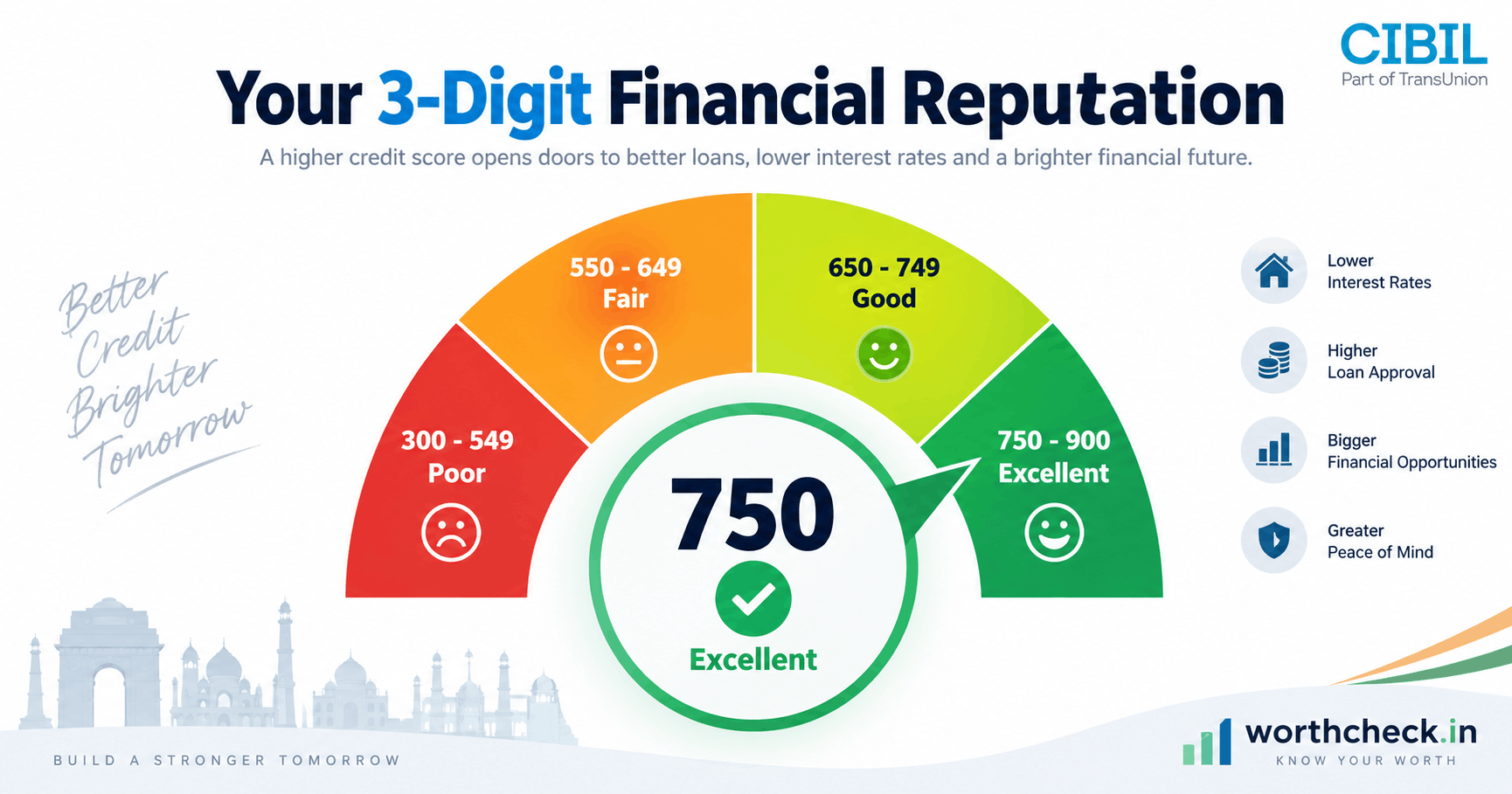
Your CIBIL score (or credit score) is a 3-digit number between 300 and 900that represents your creditworthiness. It's like a report card for your financial behavior - how well you pay your bills, manage your loans, and handle credit.
In India, we have 4 credit bureaus licensed by RBI:
| Bureau | Full Name | Score Name | Range |
|---|---|---|---|
| CIBIL | TransUnion CIBIL | CIBIL Score | 300-900 |
| Experian | Experian India | Experian Score | 300-900 |
| Equifax | Equifax India | Equifax Score | 300-900 |
| CRIF | CRIF High Mark | CRIF Score | 300-900 |
CIBIL is the most commonly used bureau in India - about 90% of banks check your CIBIL score. When people say "credit score" in India, they usually mean CIBIL score. But all 4 bureaus use similar methodology and scoring ranges.
Pro Tip: Your score can vary slightly across bureaus because they may receive data at different times. A difference of 20-30 points is normal. Focus on maintaining a good score across all bureaus.
Credit Score Ranges Explained
Not all scores are created equal. Here's what each range means for your loan and credit card applications:
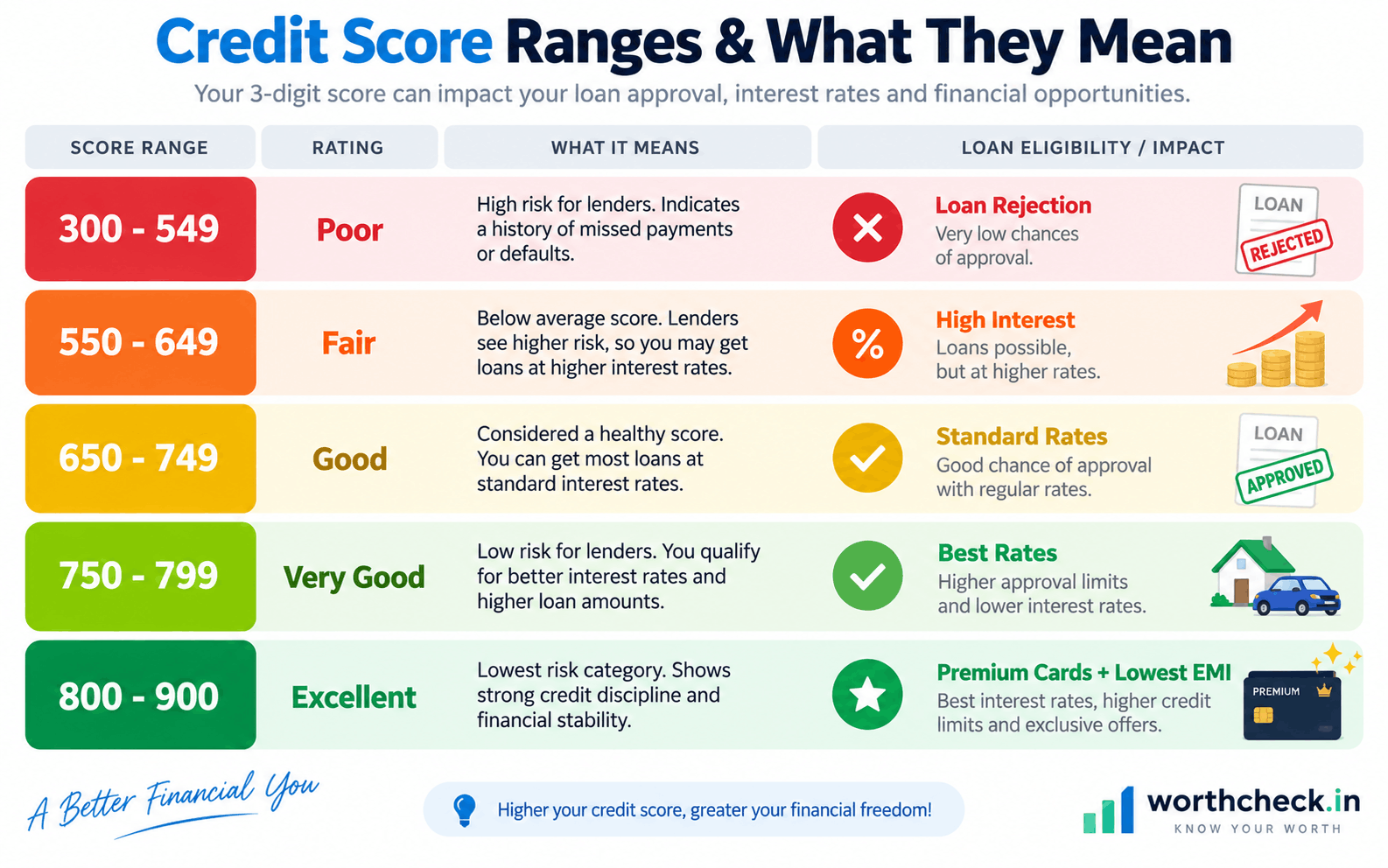
Poor
Loan rejection is almost certain. Credit cards will be declined. Need to rebuild credit from scratch.
Fair
May get loans with higher interest rates. Limited credit card options. NBFCs more likely than banks.
Good
Most loans approved at standard rates. Basic credit cards available. Still room for improvement.
Very Good
Best loan rates available. Premium credit cards accessible. Banks compete for your business.
Excellent
Lowest possible rates. All premium cards available. May get pre-approved offers. Financial freedom.
The sweet spot is 750+.At this level, you get access to the best rates and most lenders won't negotiate further. Going from 750 to 850 makes marginal difference, but going from 680 to 750 can save you lakhs on a home loan.
5 Factors That Affect Your Credit Score
Your credit score isn't a mystery. It's calculated based on 5 main factors, each with a different weightage:
Payment History
Most Important Factor
Do you pay your EMIs and credit card bills on time? Even one late payment can drop your score by 50-100 points. A 90+ days overdue account is a major red flag.
Action: Set up auto-pay for at least the minimum amount on all credit cards and loans.
Credit Utilization
Second Most Important
How much of your available credit limit are you using? Using more than 30% signals financial stress. If your limit is Rs 1 lakh, keep outstanding below Rs 30,000.
Action: Pay credit card bills multiple times a month to keep utilization low, or request a limit increase.
Length of Credit History
Time Matters
How long have you been using credit? Older accounts are better. This is why closing your oldest credit card can hurt your score.
Action: Don't close old credit cards even if you don't use them. Use them occasionally to keep them active.
Credit Mix
Variety Helps
Having different types of credit (credit card, home loan, personal loan) shows you can manage various responsibilities. Only credit cards? That's a thin file.
Action: Don't take loans just for credit mix. But if you need a loan anyway, it can help your score over time.
New Credit Inquiries
Hard Inquiries
Every time you apply for credit, the lender checks your score (hard inquiry). Too many in a short time signals desperation. Each hard inquiry can drop your score by 5-10 points.
Action: Don't apply for multiple credit cards or loans at once. Space out applications by 3-6 months.
How to Check Your Credit Score (Free)
By RBI mandate, every credit bureau must give you one free credit report per year. Here's how to check:
| Bureau | Website | Free Report | Paid Options |
|---|---|---|---|
| CIBIL | cibil.com | 1 per year | Rs 550/report or Rs 1200/year |
| Experian | experian.in | 1 per year | Rs 399/report |
| Equifax | equifax.co.in | 1 per year | Rs 499/report |
| CRIF High Mark | crifhighmark.com | 1 per year | Rs 399/report |
Free Alternatives (Unlimited Checks)
Several apps and banks offer free credit score checks (soft inquiries that don't affect your score):
- Paytm: Shows Experian score free in the app
- PhonePe: Shows CIBIL score free
- CRED: Shows free credit score with detailed analysis
- Groww, Zerodha: Show credit score in their apps
- HDFC, ICICI, Axis: Show score free in banking apps
Important: Checking your own score (soft inquiry) does NOT affect your credit score. Only when a lender checks your score (hard inquiry) does it have a small negative impact. Check as often as you want!
How to Improve Your Credit Score
Whether your score is 550 or 700, here are proven strategies to improve it. The lower your score, the faster you'll see results:
1. Pay All Bills On Time (Impact: High)
Set up auto-pay for minimum amounts on all credit cards and EMIs. Even one day late counts as a missed payment. If you've missed payments before, start a streak of 6+ months of on-time payments.
Expected improvement: 20-50 points in 3-6 months
2. Reduce Credit Utilization Below 30% (Impact: High)
If your credit limit is Rs 1 lakh, keep outstanding below Rs 30,000. Pay bills multiple times a month if needed. Request a limit increase (this also helps utilization ratio).
Expected improvement: 30-50 points in 1-2 months
3. Don't Close Old Accounts (Impact: Medium)
Your oldest credit card helps your credit age. Even if you don't use it, keep it open. Use it once every 3 months for a small purchase to keep it active.
Protects existing score from dropping
4. Fix Errors in Your Report (Impact: Varies)
Check your credit report for errors - wrong accounts, incorrect payment status, or accounts that aren't yours. Dispute them with the bureau (free process).
Can improve score by 50-100 points if errors exist
5. Become an Authorized User (Impact: Medium)
If a family member has a credit card with good history, ask them to add you as an authorized user. Their good payment history gets added to your report.
Expected improvement: 15-30 points immediately
6. Get a Secured Credit Card (For No/Low Credit)
If you have no credit history or very low score, start with a secured card (backed by FD). Use it responsibly for 6-12 months, then apply for regular cards.
Builds credit from scratch in 6-12 months
Common Credit Score Mistakes
Paying Only Minimum Amount
While it avoids late payment marks, carrying forward balance at 40%+ interest hurts you financially. It also keeps utilization high, hurting your score.
Applying for Multiple Cards at Once
Each application is a hard inquiry. 5 applications in a month can drop your score by 30-50 points and signals desperation to lenders.
Ignoring Small Dues
That Rs 500 outstanding from 2 years ago? It's still hurting your score. Clear all dues, even small ones, before applying for major loans.
Being a Loan Guarantor
If you guarantee someone's loan and they default, your score drops. Only guarantee loans for people you truly trust and can afford to repay.
Settling Loans Instead of Paying in Full
"Settled" status is a red flag. It means you paid less than owed. Banks see this as a risk. Always try to pay in full, even if it takes time.
How Credit Score Affects Your Loans
Here's the real cost of a low credit score. Let's see how interest rates change based on your score:
| Score | Home Loan | Personal Loan | Car Loan | Credit Card |
|---|---|---|---|---|
| Below 650 | 10-11% | 18-24% | 12-14% | Likely rejected |
| 650-700 | 9.5-10% | 14-18% | 10-12% | Basic cards |
| 700-750 | 8.75-9.5% | 12-14% | 9-10% | Most cards |
| 750+ | 8.5-8.75% | 10.5-12% | 8-9% | Premium cards |
Real Example: Rs 50 Lakh Home Loan for 20 Years
Score: 680 (Rate: 9.5%)
EMI: Rs 46,607
Total Interest: Rs 61.8 lakh
Score: 780 (Rate: 8.5%)
EMI: Rs 43,391
Total Interest: Rs 54.1 lakh
Difference: Rs 3,216/month or Rs 7.7 lakh total savings with a better score!
Credit Score Myths Busted
Myth: Checking your score hurts it
Reality:Checking your own score is a "soft inquiry" and has zero impact. Only when lenders check (hard inquiry) does it affect slightly. Check your score as often as you want!
Myth: I don't need credit, so I don't need a score
Reality: Credit scores are checked for home rentals, job applications, and insurance too. Building good credit now gives you options later when you might need them.
Myth: Income affects credit score
Reality: Your income is NOT part of your credit score calculation. A person earning Rs 30,000/month can have a better score than someone earning Rs 3 lakh/month if they manage credit better.
Myth: Debit card usage builds credit
Reality:Debit cards are linked to your bank account, not credit. They don't appear on your credit report. Only credit cards, loans, and EMIs build credit history.
Myth: Paying in cash is better for credit
Reality:Paying in cash doesn't build credit at all. Using a credit card and paying it off fully each month builds excellent credit while earning rewards too.
Credit Score Improvement Timeline
Improving your credit score isn't overnight. Here's a realistic timeline based on your starting point:
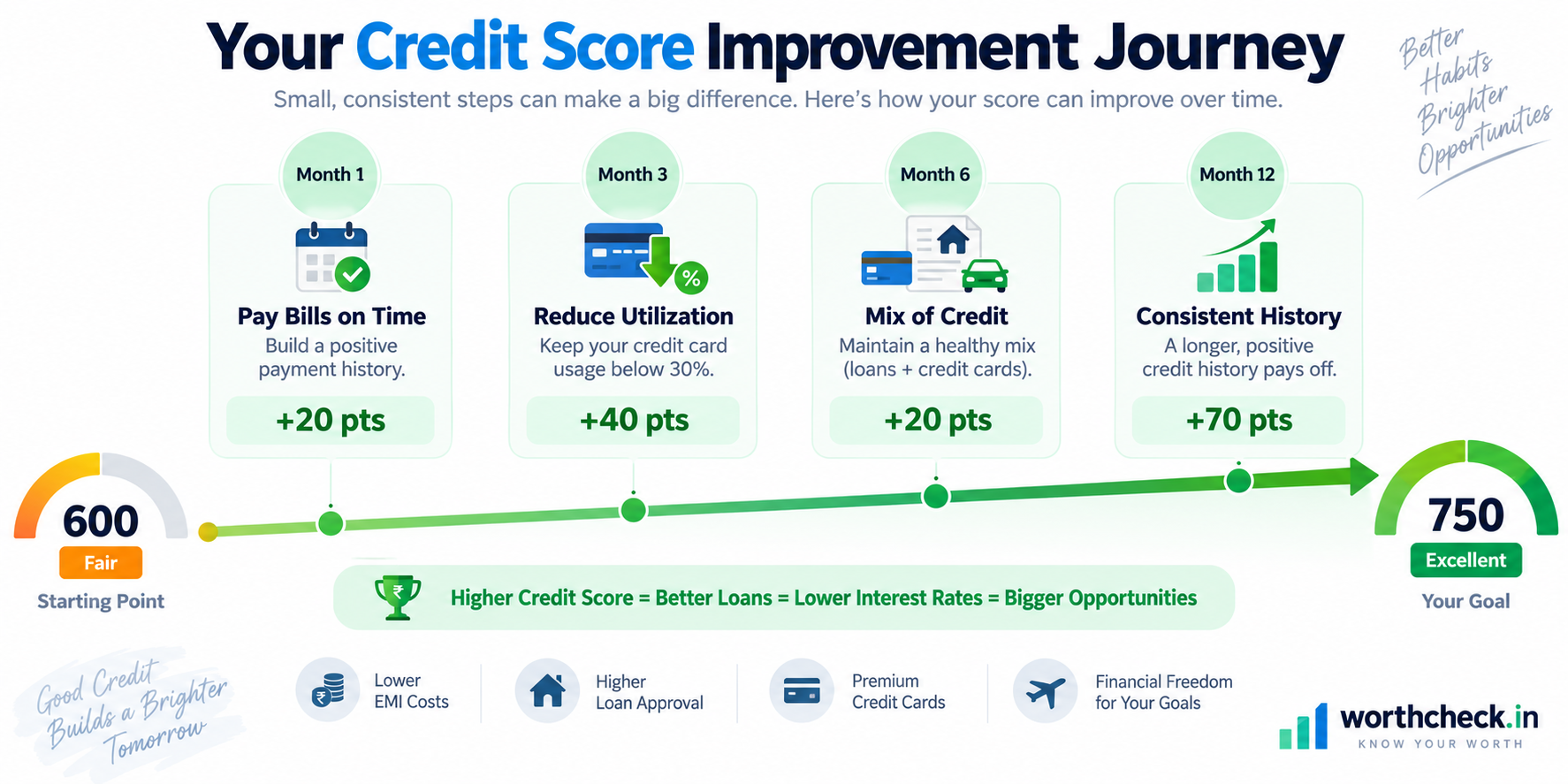
Starting from 500-600 (Poor)
- Month 1-3:Clear all overdue payments. Score may drop initially as settled accounts appear.
- Month 4-6:Start seeing improvement as on-time payment history builds (+30-50 points).
- Month 7-12:Consistent payments show effect. Consider secured credit card (+50-100 points).
- Year 2:Should reach 700+ if all payments on time and utilization low.
Starting from 650-700 (Fair)
- Month 1-2:Reduce credit utilization below 30%. Quick wins here (+20-40 points).
- Month 3-6:Build on-time payment streak. Fix any errors in report (+30-50 points).
- Month 7-12:Should reach 750+ with consistent behavior. Ready for best rates.
Starting from 700-750 (Good)
- Month 1-3:Fine-tune utilization. Request limit increases. (+10-20 points).
- Month 4-6:Should reach 750+. Focus on maintaining rather than improving.
- Ongoing:800+ possible with 3-5+ years of perfect credit history.
Final Verdict
The Bottom Line
Your credit score is like your financial reputation. It takes time to build, seconds to damage, and years to repair. The good news is that improving it is entirely within your control.
Check your score at least once every 3 months. Use free options like Paytm or CRED.
Pay all bills on time. Set up auto-pay. This is the single most important thing.
Keep utilization below 30%. If your limit is Rs 1 lakh, don't carry more than Rs 30,000.
Think long-term. Don't close old cards. Don't apply for too much credit at once.
Start today. Your future self (and your home loan application) will thank you.